
Long Distance Ice Skating
Back in the late 1990s, I was visiting Uppsala University in Sweden, where we were developing a research project on the health of the Sámi, a small indigenous population of reindeer herders in the north of Fenno-Scandinavia. One morning, our hosts took us out on a local lake to experience the Nordic sport of Long Distance Ice Skating. My future postdoc, Patrik Magnusson, led this excursion, and I liked it so much that we went to the store afterward so I could buy my own pair of skates, which are very different that conventional hockey or figure skates, being very flat and very long, and attaching themselves to one’s ski boots, from which they can be removed when one has to cross bits of land. These skates were originally used for transportation on the multitude of lakes and seas in Scandinavia, for such things as delivering the mail between cities. One can easily skate 15-20mph without even breaking the aerobic threshold, meaning that you can carry on a conversation easily at that speed without being the least bit winded. Much faster than hockey skates… The technology developed rather quickly after I bought my first skates, such that now one uses cross country ski boots, and the skates only attach to the toe of the boot and there is a spring action that makes the skate slap back to the boot when lifted in the air after each stride. Makes it even faster and easier.
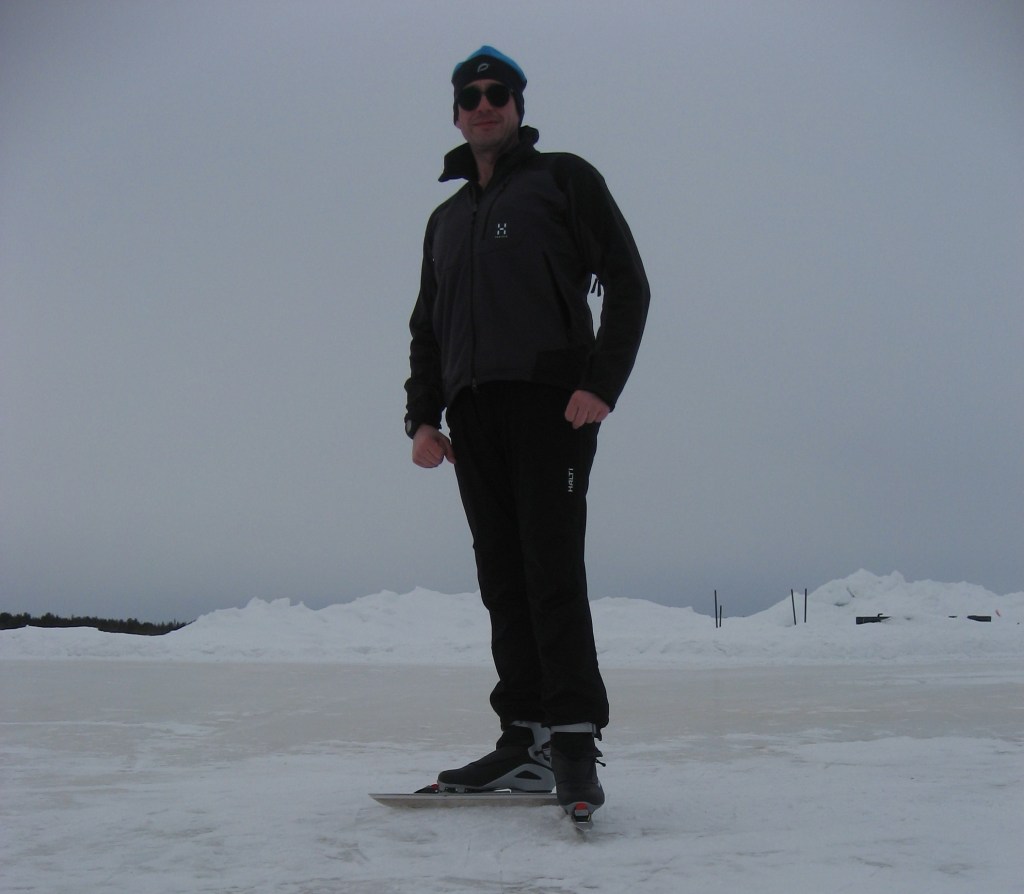
Anyway, over the subsequent decades, I found myself partaking in the sport whenever I had the chance and there was sufficient ice. In Helsinki, I would skate often on Laajalahti when there was sufficient ice, or on Tuusulanjärvi near Järvenpää. When back in North America, I found myself traveling to Canada every winter to stake on Lake Champlain, Rivière L’Assomption in Joliette, Quebec, or Lac Masson in the Laurentians, or on the Rideau Canal in Ottawa. each of these were great spots to speed past Canadians on the ice, while they tried to keep up using traditional hockey skates. I rather enjoyed skating past them yelling USA! USA! USA! when they tried to keep up and I had to put on the gas!

I still try to get up North every year to skate a few dozen miles and enjoy the feeling of cold winter air on my face, especially when I have my beard to catch the ice and snow as insulation! Below I will post some photos and videos from each of those locations together with some GPS tracks to show where I was. The most extreme moment I felt was near the end of the Rideau Canal, where the skateway goes though a large open field and it turns out that it has a slight incline away from the canal… When I skated back towards the canal, I realized I was going way too fast, with wind behind me and heading downhill… I looked at my Garmin GPS watch and apparently I was skating about 40 miles per hour. At that point I stopped moving my legs and got into a tuck position where my balance was optimized and gradually slowed to a more normal pace without disaster… I also figured if I was low enough to the ground, if I did fall, I could fall properly into the direction I was skating so as to slide rather than crash! Fortunately the Rideau Canal is zambonied so there were none of the crevices and cracks you normally see on natural ice in Sweden and Finland!
Finally in 2010, I was in Scandinavia when there was enough ice on the sea for the famous Vikingarännet (Viking Run) race to be held on the full course from Uppsala to Stockholm (80km). The full story of that experience can be found here.
Below I will show various photos and videos from all the other skating spots mentioned above.
