
Around the World (i.e. Manhattan) in (less than) 80 Days!
Total Steps as of January 22, 2005 = 1,931,006
Which equals roughly 1279 miles or 2057 km
In September 2004, when teaching a course on “Logical Reasoning in Human Genetics” at the National Public Health Institute in Helsinki, Finland, I was given a pedometer by the Institute as a gift for the teaching. I started to monitor my average daily walking, and it turned out to be a meager 5000 steps, which at roughly 1510 steps to the mile, was only 3.3 miles a day, which was basically walking to work and home two or three times a day…
Realizing that I was overweight, and needed to get in shape after a year on the road travelling in foreign countries eating wonderful food and not exercising at all, I decided that this year in my annual November-December getting in shape period, that I would walk every block of every street in Manhattan again as quickly as possible. I had done it once before over the course of an entire year, in 2002, but this time I decided to try and do it in two months by the end of 2005. At that point I weighed about 250 pounds, and had a 40 inch waist, and knew I had to fix it while I had the chance, knowing I would not leave NYC again until February.
As a mathematician, I had to first define the task specifically and rigorously, such that I could clearly know when I had finished, by answering the question “how do you define a ‘street’” for purposes of walking every block of every street? I decided for purposes of this project the rational definition would be that a street is any roadway that has facilities for both pedestrian and motor vehicle traffic. I excluded private drives, as those are not public streets, and to have a consistent definition, based on the structure of NY city streets, I defined public streets further as streets defined as above which are connected to other streets by continuous pavement, and here I use the word in the American definition of pavement (for some bizarre reason Brits call the sidewalk the pavement, a ‘false cognate’ between British and English languages which got me in trouble with the police for misunderstanding when I lived in oxford…). Private roads and apartment driveways are typically connected to the street by recessed sidewalks made of sidewalk concrete, rather than asphalt. Furthermore, if there were a fence or sign restricting entry as a “private drive”, it was not counted as a street. Furthermore, since the roads through the various parks are not intended for pedestrian use, those were not counted either, though obviously many traversals of central park and others were necessary to complete this task. The Manhattan Greenway on the waterfront as well is not technically a street by these definitions, yet I did walk that as well, independent of the goal of completing every street in town.
Examples of things that were not considered streets would include “East 4th Street Walk” which is a pedestrian path that has a name and addresses, but is clearly not meeting my definition of a street; 14th ad 15th streets, east of Avenue C, as they are fenced off, and have restricted access, as does, for example, Washington Street between Barclay and Vesey; Academy Street, east of 10th Avenue, as it is fenced off, and many occurrences of “Marginal Street”; and most of the Henry Hudson Parkway, south of the George Washington Bridge, as only in the North does it have pedestrian paths. Same argument holds for the FDR and Harlem River Drives, excepting those areas where they do have pedestrian pathways, which are scattered all along the East of Manhattan Island.
Examples of things that are nonfunctional and useless streets, but nevertheless met my definition of ‘street’ and were thus walked, include the block of W. 134th street which goes under the West Side Highway and ends at a brick wall, and is surrounded above and on all sides by walls – basically a half block long tunnel to nowhere; the same street between Lenox and 5th Avenues, which basically is going nowhere, and is about 50 feet long like the cross of a T sticking below Lenox Terrace; the various sidestreets East of Pleasant Avenue, which gradually terminate in a big dirt filled vacant lot construction site; etc…
The next question was how to define the limits of “Manhattan”. I decided to use the political definition of New York County, which, for historical reasons includes the region of Marble Hill, across the Harlem River, Roosevelt Island in the East River, and Wards and Randall Islands which the Triborough Bridge crosses. Furthermore, all East River and Harlem River bridges are considered to be in Manhattan until they cover land in the Bronx, Queens, or Brooklyn, so those are all considered streets, as they have facilities for both pedestrian and motor vehicle access (excepting the Alexander Hamilton Bridge, which does not admit pedestrians). This meant that I ended up having to cross the Triborough Bridge from Wards Island to Astoria on what turned out to be a snowy day, which is NOT a fun thing to do!
So, my goal was to walk every block of every street in the Borough of Manhattan in New York City, starting from Marble Hill on October 28 and working my way down to the bottom. In the beginning I was averaging only about 10,000 steps a day, but it quickly edged up to an average of 20-30 thousands (15-20 miles). I started marking it off on a wall map of New York in my office, and keeping track of the total steps. I had hoped to finish by the end of 2004, but as I had a visitor for a week in December, and had to visit my mother for Thanksgiving and Christmas holidays, and it was a busier season than usual for tuba jobs, it took a couple weeks longer than planned. As of January 14, I had walked over 1200 miles, and lost about 45 pounds, and finished by walking across the Triboro Bridge to Astoria this afternoon, just in time to get home and have my euphoria crushed by the Jets once again…
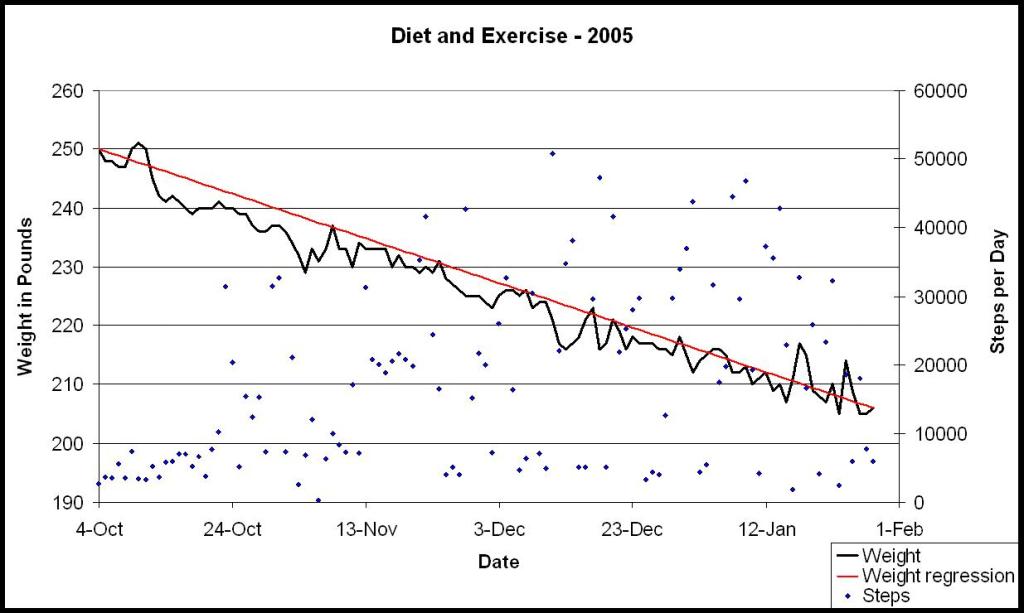

Some interesting trivia and opinions
- Number of friends I ran into by chance while walking (excluding, of course, my own neighborhood): 4 (and interestingly, they are all trombone players, and were all met by chance on different days in very different neighborhoods from Harlem to the Village…) I guess that says something about my circle of acquaintances, or maybe it says something about Trombone players 😉
- Most dangerous segment: Climbing a bare face rock covered in ice under the Henry Hudson Bridge to get to the pedestrian walkway which is unmarked from the path coming from 218th street towards the bridge.
- Most dangerous Zipcode 10039: (South of the Polo Grounds Projects around 150s and Frederick Douglass). When walking here at 3PM a group of men hanging out on the corner turned to me and said “Good afternoon, Officer”… Nice to know I looked like an undercover cop, so that they were more intimidated by me than vice versa – being a big tall guy with short hair is a good thing some times 😉
- Most steps in a single day: 72,351 (48 miles) on December 18
- Most scenic vistas: Triboro Bridge between Wards Island and Astoria
- Least favorite neighborhoods: SoHo and Upper East Side – too many tourists, “suits”, and folks who would be scared to death by the thought of walking around Mott Haven or Crotona Park East after dark…
- Most shocking discovery: The variation in the prices of Dunkin Donuts in different neighborhoods. I always order an extra large Vanilla coffee, and the price within Manhattan ranges from as low as $1.64 to as high as $2.57. In one neighborhood, I even saw two Dunkin Donuts within 0.25 mile of one another, both in a similarly depressed neighborhood, at which the price differed by 58 cents! Also shocking is how some of them add tax on top of the menu price while others do not. Amazing… I suggest the Dunkin Donuts index might be slightly more sensitive in general than the McDonald’s Big Mac index so often used to compare cost of living to salary in different places!!!
- Least pleasant segment of the walk: Crossing the Henry Hudson Bridge in 20 degree weather with 30 mile an hour wind gusts…
- Biggest Annoyance: Bicycle Riding Delivery People. These bicyclists are absolutely crazy in this city and are a total hazard because they fail to follow the rules of vehicular traffic! Going the wrong way on one-way streets, failing to yield to pedestrians, refusal to wait at red lights as they are supposed to, riding on sidewalks, failing to use headlights and bells (note that the latter are always used in Europe, and it is not for the safety of the cyclist, but for pedestrians so they can be seen and heard at night!!!) Unless they are willing to follow the rules, they should be banned from the streets and relegated to the parks where they are less of a nuisance! And note, I write this as one who cycled everywhere when I lived in Oxford for two years, where I made damned sure to learn the traffic rules and follow them unequivocally… Especially for someone like myself who walks 4-5 mph, with the momentum of my size it is insane to be expected to stop and swerve to avoid these menaces…
- A year later (while still doing a lot of walking), I was interviewed by the New York Post while carrying a 6/4 Hirsbrunner tuba on my back across the South Bronx to a Christmas Eve gig when the subway workers were on strike… While I like walking, too much is too much…

Media reports of my effort
Walking the World: San Francisco Chronicle (2005-12-18)
He Treads Manhattan – NY Daily News (2005-04-18)
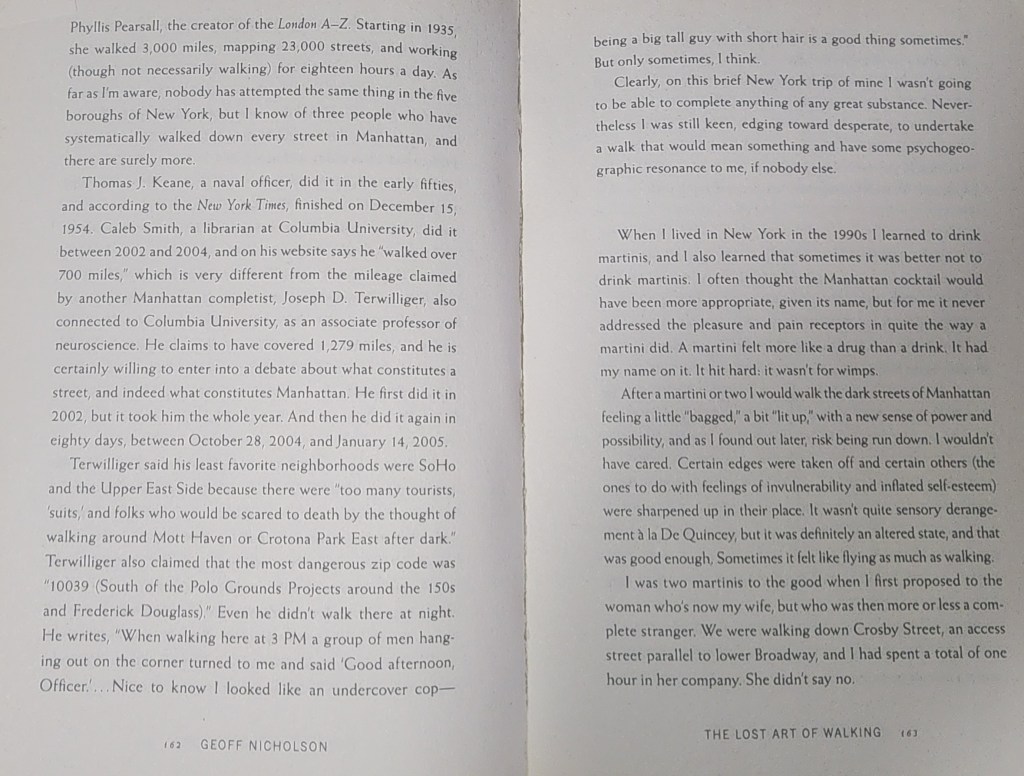
The Lost Art of Walking – Geoff Nicholson – Riverhead Books, NY (2008)
Great Saunter
Of course no story of walking every block in Manhattan would be complete without a couple runs around the Greenway – the annual Great Saunter covers the 32 miles of the Greenway that circumnavigates Manhattan. While I did not do this as part of my initial walk, as I only covered actual streets, not paths through parks, I have completed the Great Saunter on several occasions. If you are ever in New York City the first Saturday of May, I highly recommend participating in this annual event – its longer than a marathon, and a lot more fun!

Mapping my progress
The following set of photos shows the progress and distances travelled, as I started photographing the map on November 29, and progressed from there as follows. Before the historical shots, however, the current status of the walk is shown – in this case, as of today, January 22, 2005. Note that on January 14, 2005, I had finished every block of every street in Manhattan, and had begun to walk The South Bronx 😉
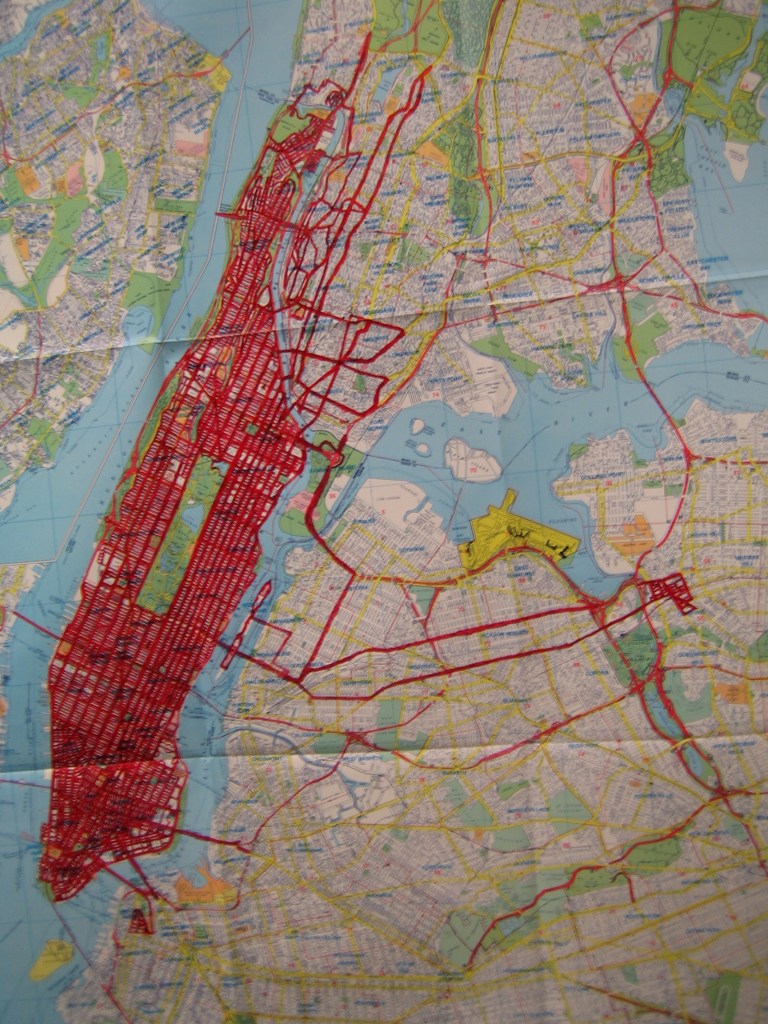
In the first month, before I started photographing the wall map, from October 28 to November 29, I walked a total of 595587 steps, I had finished the streets as shown on the following map
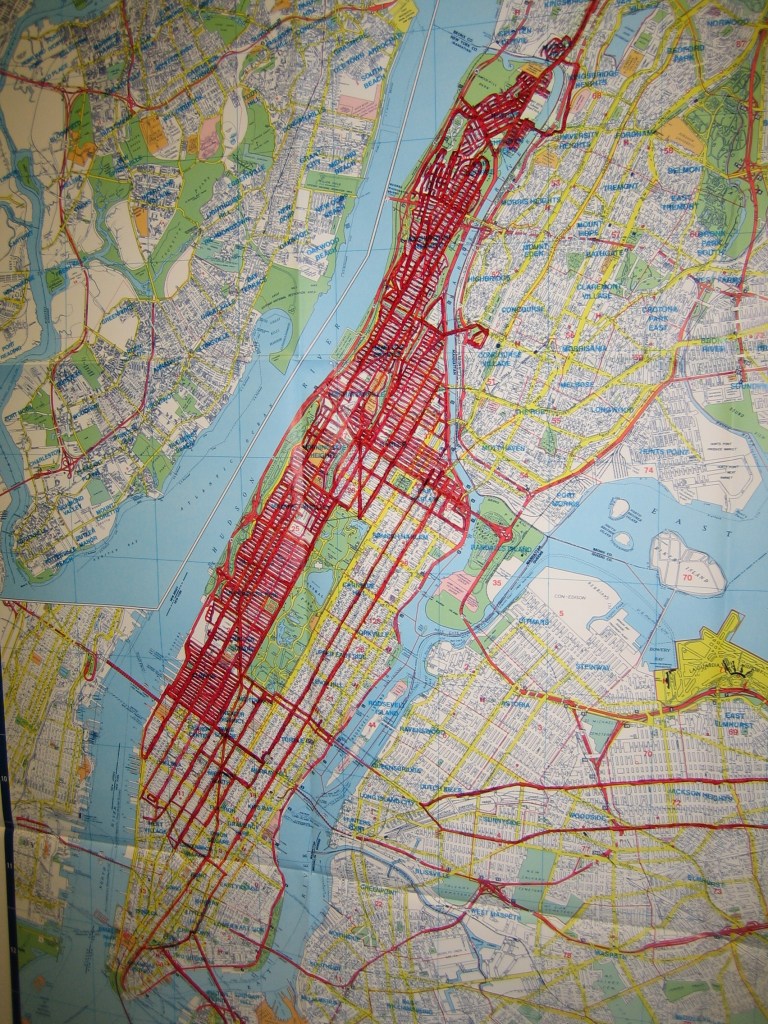
December 6 (after 128,588 more steps)

December 21 (after 349,889 more steps)
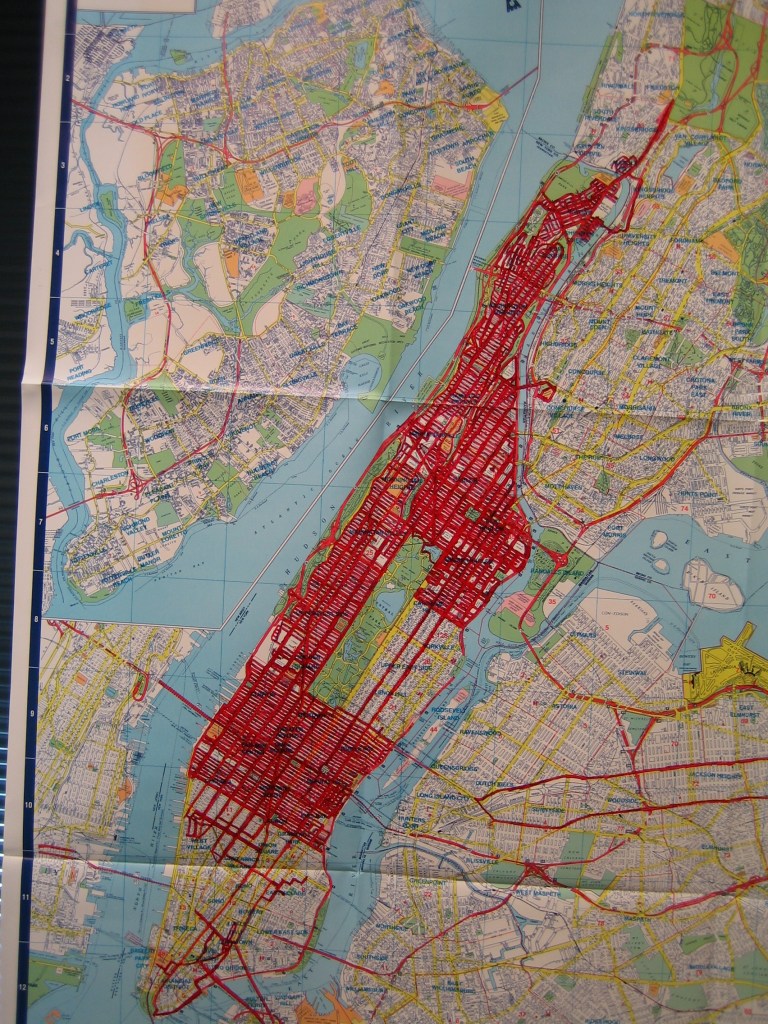
December 23 (after 53,352 more steps)

December 28 (after 81,886 more steps)
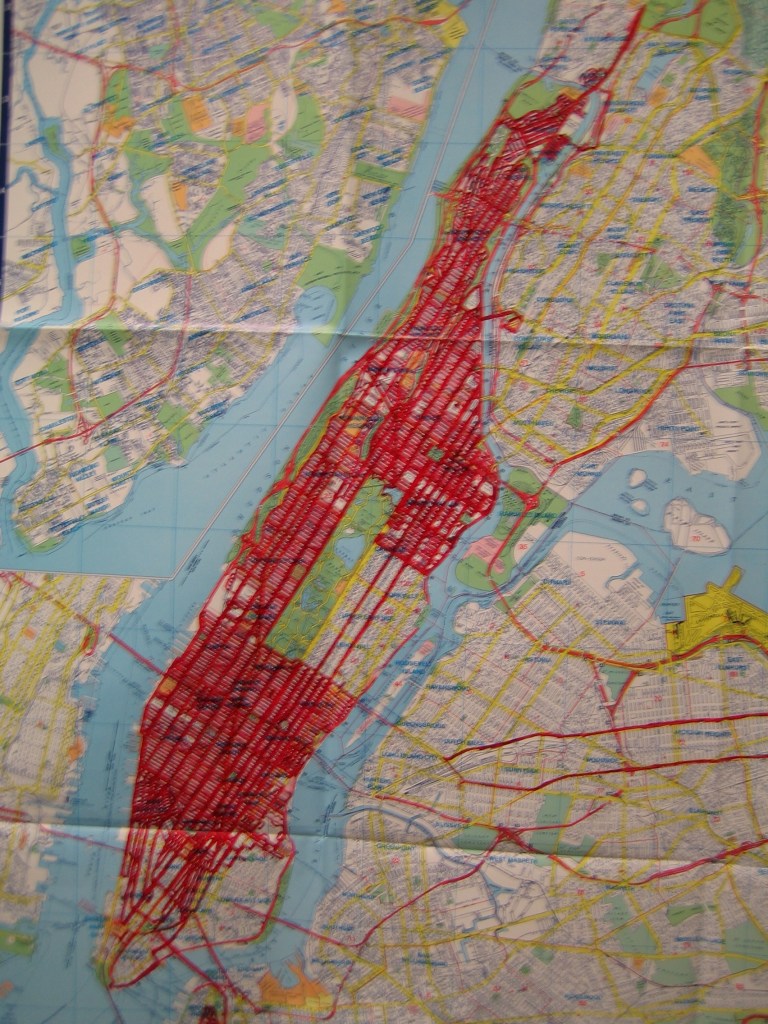
December 31 (after 113,161 more steps)
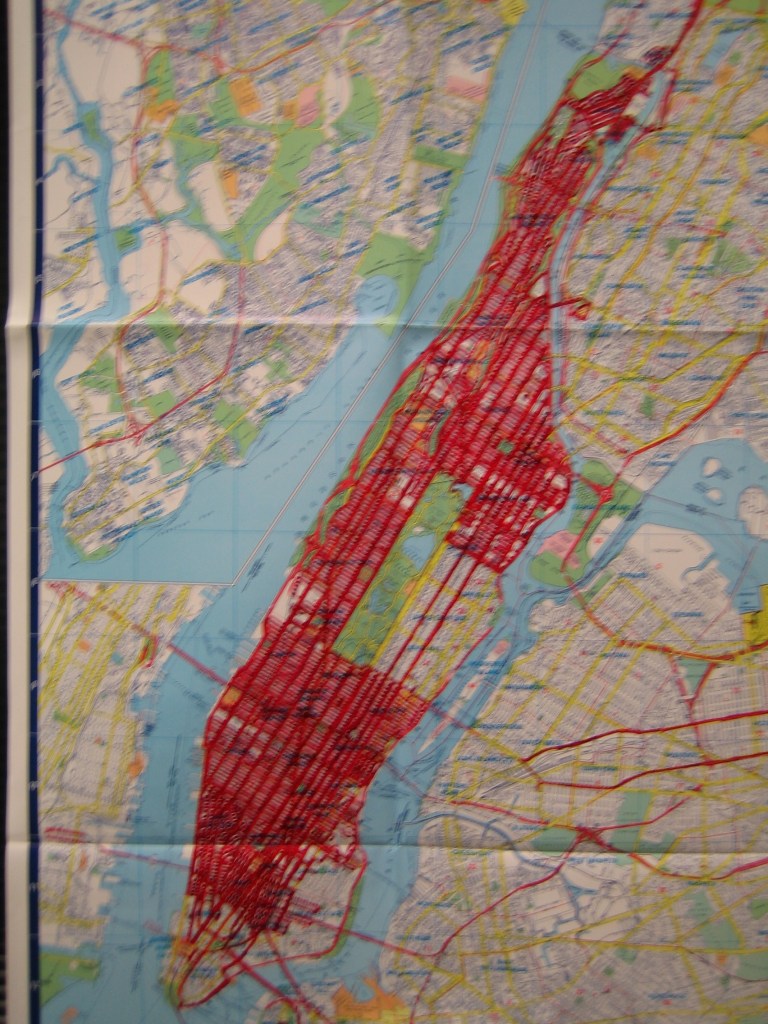
January 1 (after 43,753 more steps on New Years Day alone)
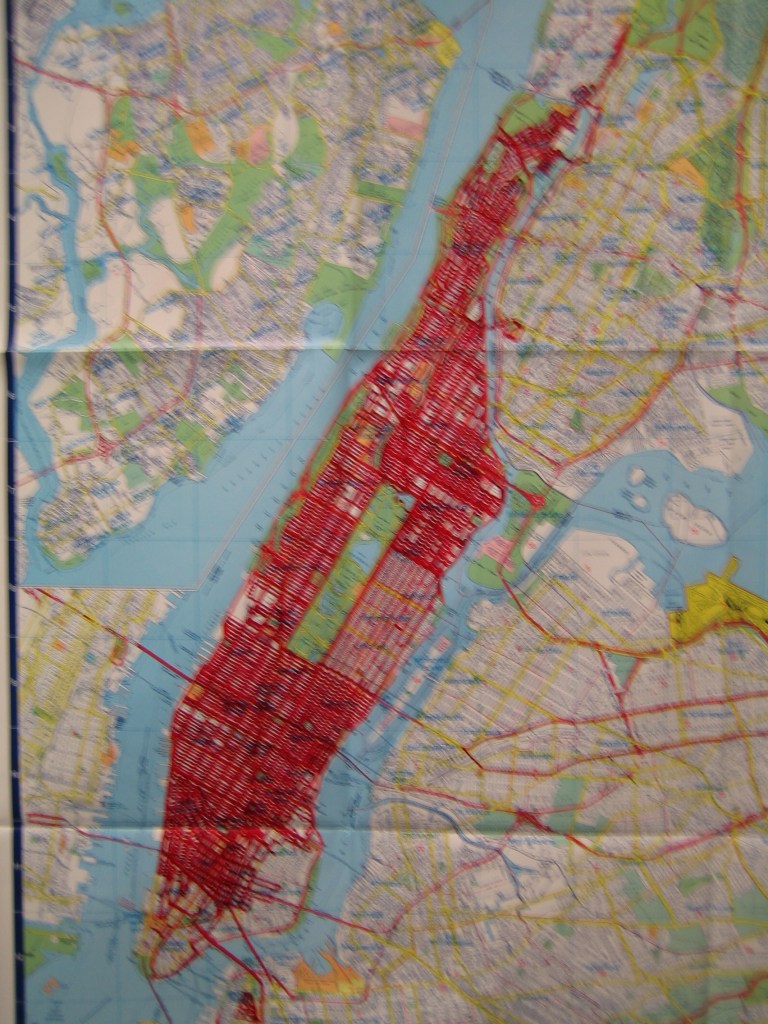
January 9 (after 199,221 more steps)
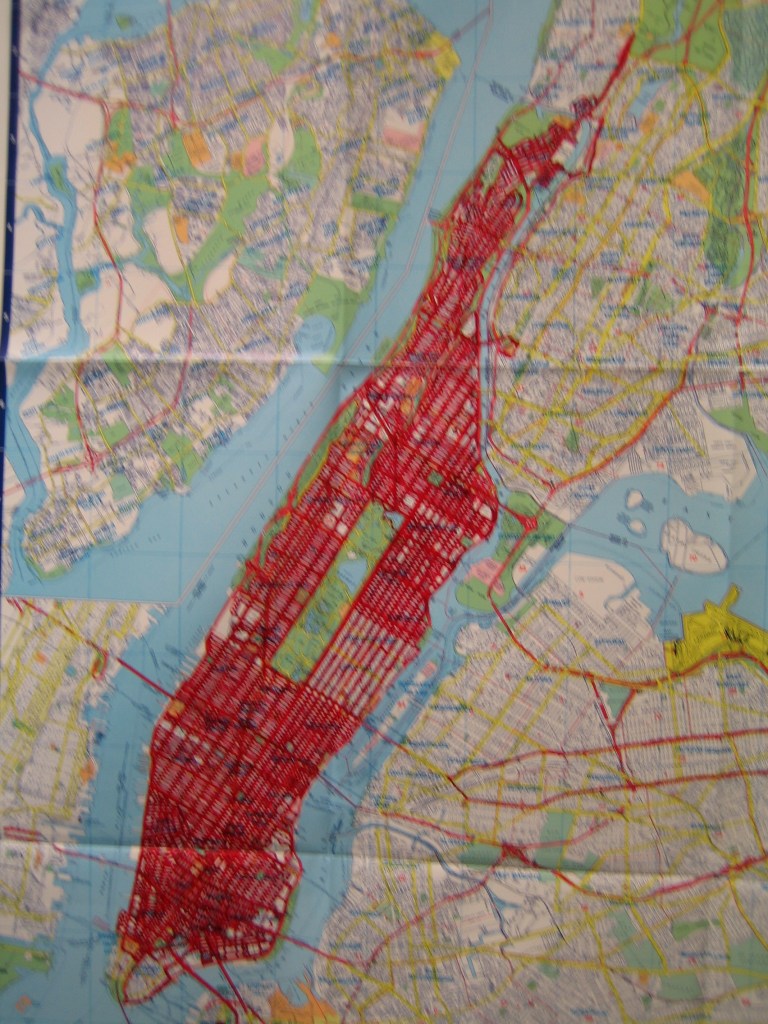
January 12 – (after 68,742 more steps)
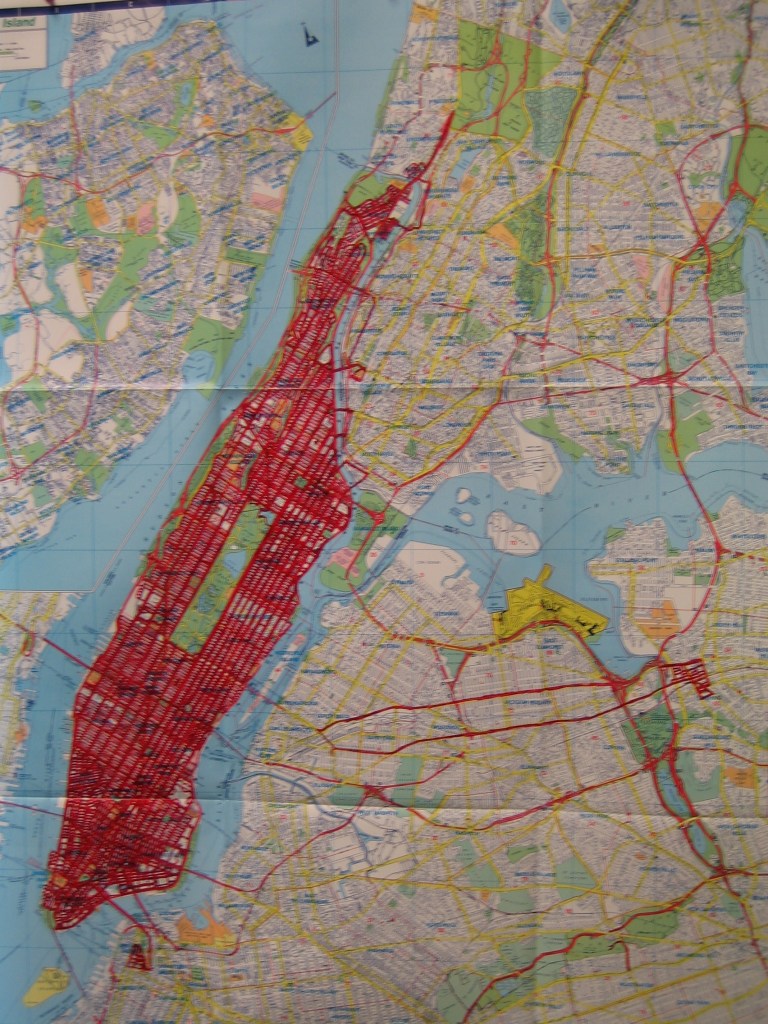
January 14 – (after 115,714 more steps – YES, THAT IS 77 MILES IN TWO DAYS!!)

January 15 – (after 22,816 more steps)

January 18 (After 49,399 more steps)

January 22 – (After 85,409 more steps including 32,213 during the Blizzard on 1/22)
